
Cell and Gene Therapies in 2026: CGT Affordability Signals for Payers to Consider
Posted on October 7, 2026
High Concern, Uneven Uptake, and CGT Market Signals for Payers
Key Points:
- Recent research shows that most payers expect cell and gene therapy (CGT) affordability to be a moderate or major challenge, yet many leaders report low confidence in their understanding of CGTs’ financial impact.
- CGT uptake has been slower than expected, with label changes and some product exits.
- Payers must tighten CGT claim visibility, align coverage and payment pathways, and revisit strategies as the market changes.
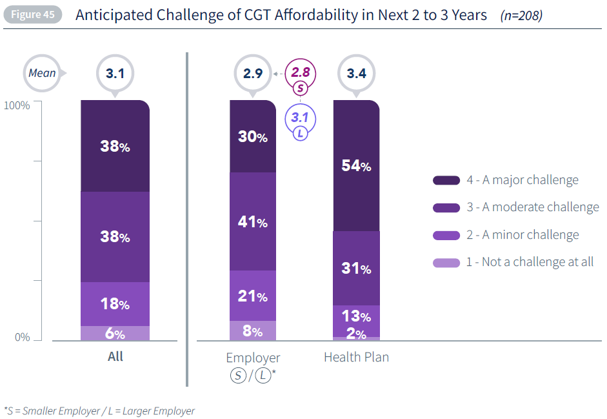
Cell and gene therapies (CGTs) still sit near the top of the “watch closely” list for payers, even as the market has not evolved the way many expected. In PSG’s latest research from the 2026 Trends in Specialty Drug Benefits Report, most respondents anticipate CGT affordability will be a moderate or major challenge over the next two to three years. At the same time, many benefits leaders say they are not confident in their organization’s understanding of the financial impact of CGTs. In this blog, we will translate those findings into four real-world examples that demonstrate the CGT market’s unpredictability and outline practical steps payers can take today to stay ahead.
2026 CGT Market Summary
Cell and gene therapies (CGTs) offer a different approach than traditional treatments. They are often administered one time and can be curative, but they usually carry high price tags and complex administration requirements. The CGT landscape continues to change as new therapies enter the market and existing therapies pursue expanded indications. In PSG’s survey, 76% of payers anticipate CGT affordability will be a moderate or major challenge in the next two to three years.
At the same time, CGT utilization has not followed a linear growth trajectory. Uptake has been slower than expected, product labels have changed in response to safety events, and some approved therapies have been discontinued or removed from the market. Despite those headwinds, CGTs are still coming to market, and payers are seeing utilization in high-impact areas such as pediatric rare disease and certain oncology CAR T-cell therapies.
Given this mix of upward and downward pressures on CGT utilization, it is unsurprising that our recent report also found that the overall majority of respondents are not at all or just somewhat confident in their understanding of CGTs’ financial impact over the next few years. Health plans report greater confidence than employers, but the broader takeaway is the same: leaders see the risk, yet many do not feel fully equipped to manage it.
Below are four real-world CGT examples that illustrate why the market feels unpredictable and what payers can do right now to reduce surprises.
Example 1: Spinal Muscular Atrophy and One-Time Gene Therapy, from Zolgensma to Itvisma
Spinal muscular atrophy (SMA) remains one of the most visible gene therapy stories because it blends a rare genetic neuromuscular disease that is a leading genetic cause of infant mortality with a one-time treatment model and multi-million-dollar pricing.
Zolgensma is one of the most widely used CGTs, listed at a price point of $2.13M, with use limited to children under age 2. Novartis, the manufacturer of Zolgensma, brought another gene therapy, Itvisma, to market in November 2025 for patients age 2 and above, available at a price point of $2.59M. Both drugs are one-time treatments that contain the same active ingredient, targeting the root genetic cause of SMA and eliminating the need for lifelong chronic treatments.
The market signals here are price, expansion of the addressable population, and the operational implications of a one-time therapy with higher upfront costs paired with coordination of treatment and the development of UM and coverage considerations.
Payers must confirm how their medical benefit policies, prior authorization criteria, and case management workflows will handle an SMA gene therapy that extends beyond the youngest pediatric population. It is also important to align with vendors on how eligibility, site of care, and reimbursement will be managed so payers can avoid being caught off guard when the first case occurs. Payers should also consider value-based or outcomes-based reimbursement models.
Example 2: CAR T-Cell Therapies With a Lower Cost Per Claim but Rising Utilization
While multi-million-dollar gene therapies often dominate headlines, oncology CAR T-cell therapies can drive meaningful cost impact through volume. A great example is Yescarta, priced around $500,000, which is one of the most widely used CAR T-cell therapies designed for treatment of B-cell lymphomas. Despite the relatively low list price when compared with other CGTs, utilization can make this therapy a financial challenge.
The key shift is clinical. CAR T-cell therapies are proving effective enough that they are being moved earlier in treatment regimens, from a last-resort option to a second-line treatment in some cases. That change increases the number of eligible patients, which increases utilization and makes their costs more visible to payers.
Additionally, in June 2025, the FDA eliminated the Risk Evaluation and Mitigation Strategies (REMS) for CAR T-cell therapies including Abecma, Breyanzi, Carvykti, Kymriah, Tecartus and Yescarta that are used for treatment of certain blood cancers. This change reduces provider burden, expedites delivery of potentially curative treatments, and ultimately expands access for patients.
To meet the rising utilization, payers are exploring centers of excellence models to improve service quality, optimize reimbursement, and contain costs. Centers of excellence offer the specialized expertise and infrastructure, as well as safety and toxicity management, that are needed to administer these complex therapies.
Multiple FDA-approved CAR T-cell therapies available in the U.S. have been shown to be very effective for hard-to-treat cancers. Payers must be careful not to let these comparatively lower-cost CGTs become a lower priority to manage. Payers should start by building better visibility into when CAR T-cell therapy claims occur, including the associated reimbursement and ancillary charges. Then they should assess whether a centers of excellence strategy is available and realistic for their population. Both steps help payers manage member experience, access, and total cost of treatment as utilization grows.
Example 3: Roctavian Withdrawal and What It Reveals About Demand, Competition, and Alternatives
Not every CGT becomes a durable, category-defining product. Roctavian entered the market in 2023 with the promise of transforming treatment as a one-time therapy for patients with severe hemophilia A. Due to low commercial demand and low sales, Roctavian has since been withdrawn from the market and availability ended in May 2026.
This outcome is connected to a practical market reality: existing hemophilia A therapies were already very effective for many patients, which reduced the need for patients to pursue a gene therapy option. For payers, the lesson is that CGT risk is not always about new launches; it is also about the pace at which the standard of care evolves and how competitive clinical alternatives shape real-world uptake.
Payers should use this moment to take a harder look at how members with hemophilia are managed today relative to established clinical standards of care and service and to ensure current drug therapy is optimized. One example is keeping treatment performance, impact to spend, and opportunities for improvement in view through quarterly clinical updates from their vendor partners.
Example 4: Impact of Rapid Expansion Followed by a Targeted Safety Restriction for Elevidys
Elevidys, a widely discussed CGT for Duchenne Muscular Dystrophy (DMD), launched under tight restrictions. When the FDA granted accelerated approval in June 2023, eligibility was limited to ambulatory pediatric patients ages 4 to 5 with a confirmed DMD gene mutation, encompassing roughly 3% of the DMD population.
One year later, the picture changed substantially. In June 2024, the FDA expanded the label to grant full approval for all ambulatory patients age 4 and above, along with accelerated approval for non-ambulatory patients in the same age range. Access jumped to an estimated 90% of DMD patients, and utilization spiked accordingly.
However, in mid-2025, safety concerns emerged after two ambulatory patients died, linked to acute liver failure after receiving Elevidys. This caused the FDA to step in, making post-market changes and adding safety guardrails in November 2025, including a label change completely removing the indication for non-ambulatory patients and adding of a strict boxed warning for serious liver injury and acute liver failure. As a result, utilization decreased sharply, with commercial use for non-ambulatory patients ceasing completely.
Utilization management is very important to ensure the appropriate and safe use of Elevidys for the right patients. Payers should work with their vendors to ensure the right policies and processes are in place for proper use of this CGT.
Closing Thoughts: Plan for Volatility, Not a Single Forecast
If CGTs have taught the market anything, it is that pipeline potential does not equal smooth adoption. Uptake can slow due to label changes, safety signals, operational burden, or strong existing alternatives, and some products may exit altogether. Yet concern about affordability remains high, and many leaders still lack confidence in their ability to quantify the financial impact of what is coming.
The best response is a repeatable playbook in which payers tighten visibility into CGT claims, align coverage and payment pathways before the first case arrives, and revisit strategies as indications, utilization patterns, and market participation change. Payers that build this practice now will be in a better position to manage both the rare, multi-million-dollar cases and the lower-cost, higher-volume therapies that can quietly reshape their trend lines. To learn more about navigating the evolving CGT landscape and what it could mean for your organization, reach out to our expert team.


